
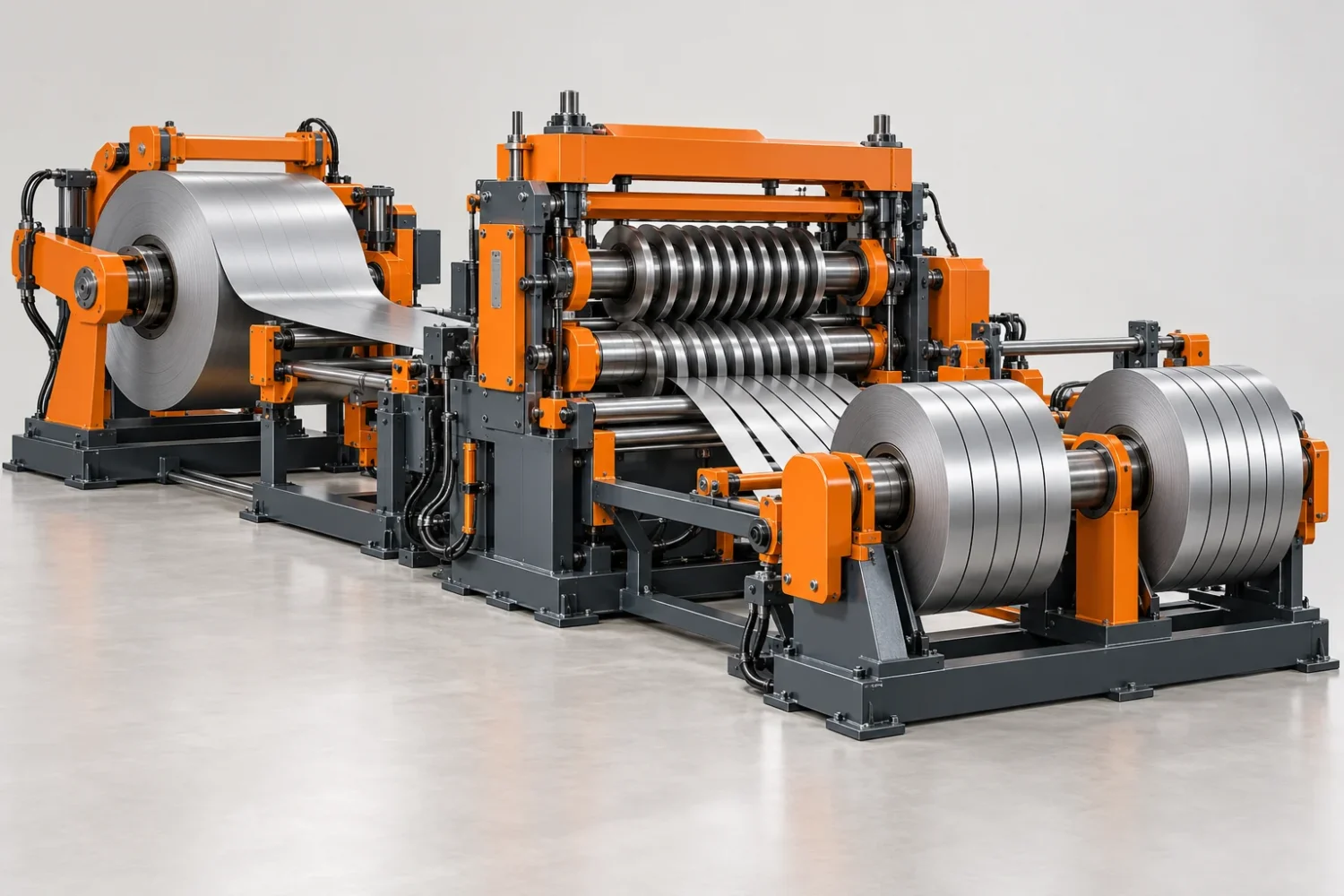
Slitting and cut-to-length processing may begin with the same raw material: sheet metal coil. Their outputs and purposes are different, however. The starting question is what your next production operation needs.
Slitting produces narrower strip coils
Slitting cuts a wide master coil longitudinally into narrower strips. These can be recoiled for downstream processing. The requirement should include strip widths, cutting patterns, coil weights, surface expectations and edge quality. Tooling arrangements and changeover procedures are also connected to the product mix.
Cut-to-length produces sheets
A cut-to-length line unwinds the coil, levels it as required by the process and cuts it to the requested length. Flatness, surface protection, sheet handling and stacking matter as well as length. The next operation might be laser cutting, pressing or another process, and acceptance criteria should reflect that use.
A combined line is not automatically the right choice
Bringing several operations into one arrangement may suit some production programmes. Product mix, setup time, available space and the effect of one operation waiting for another must still be reviewed. Separate and combined line concepts should be compared using realistic production scenarios.
Start by describing the output
Do you need strip coils or flat sheets? What are the dimensional range, material group, batch sizes and downstream machine requirements? Clarifying these points helps avoid requesting quotations for the wrong process. Put capacity and quality expectations into measurable acceptance criteria.